Civic Regalia
Images relating to Gloucester's historic civic office.
The Sheriff's Chain and Badge
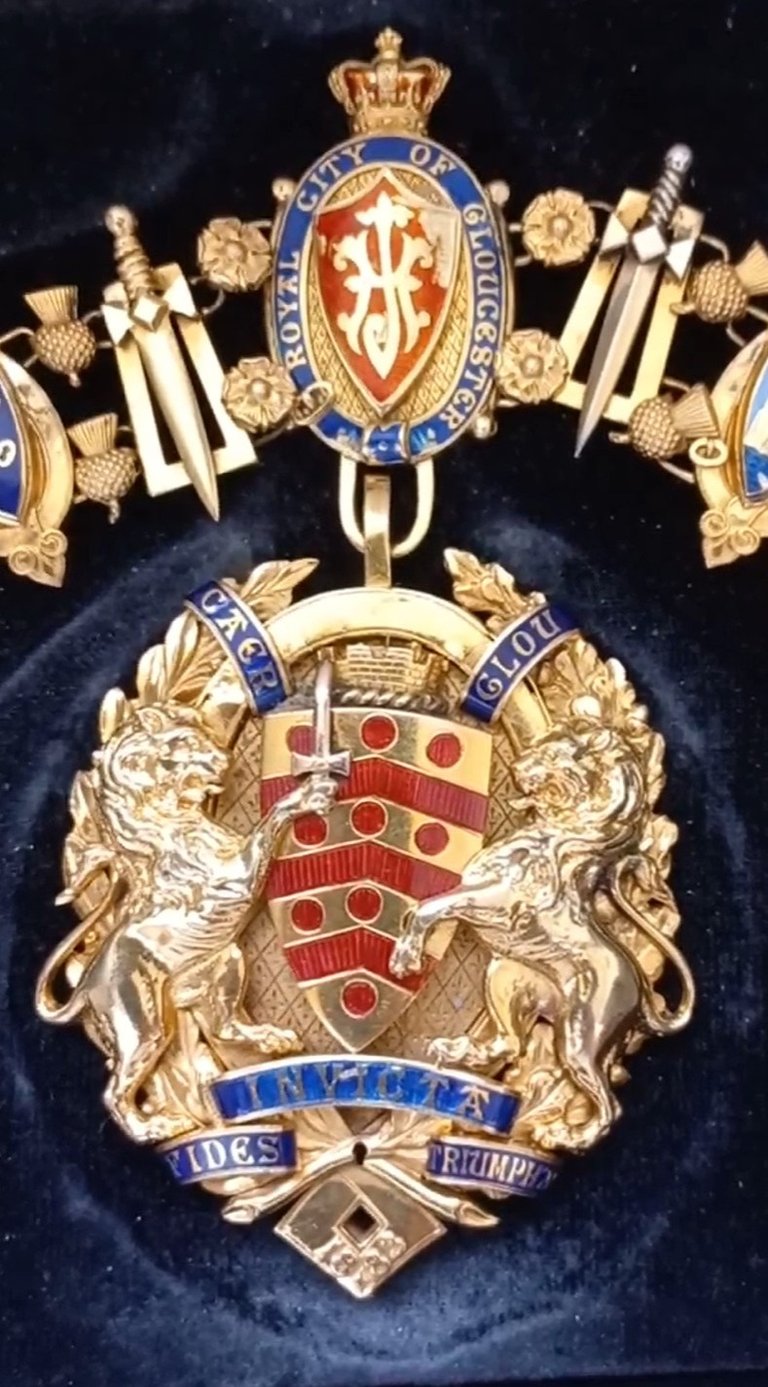
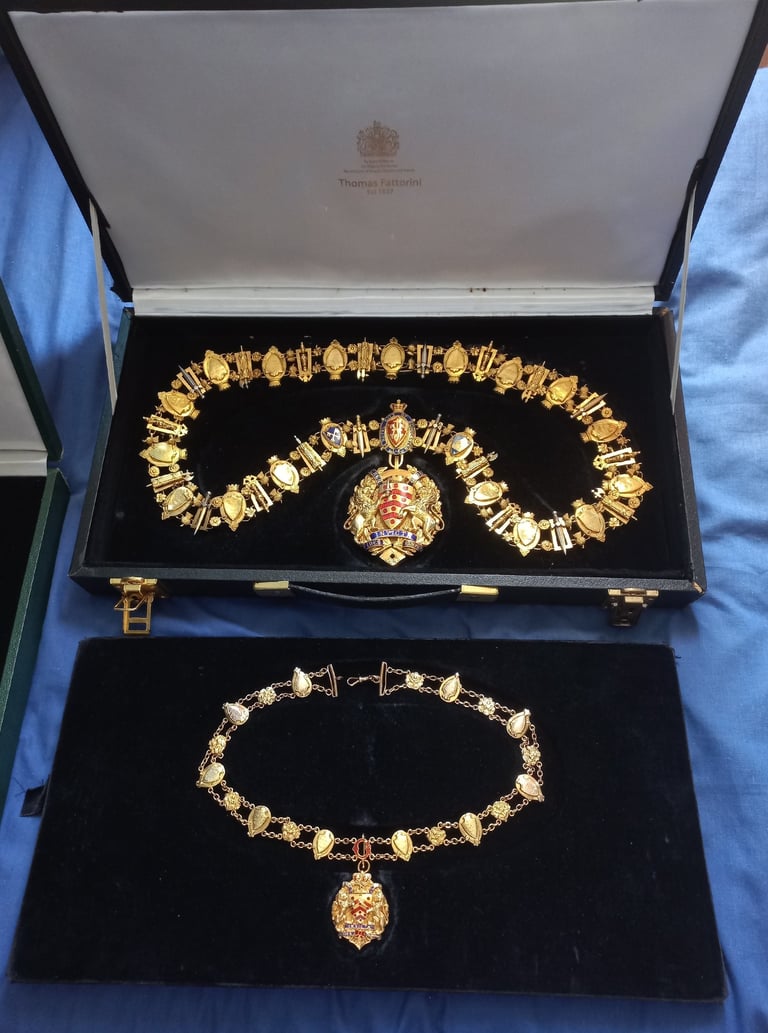
The chain is made up of alternate links of garter and shield, with mural crowns at the top and blocks containing emblems of the Sheriff’s office in front, comprising the sword and fasces, with axe and mace. These are linked up with the national emblems of the rose, shamrock and thistle, joined together. The central link is a larger garter and shield surrounded with the royal crown, and bearing on the centre of the shield the monogram “HJ” in purple enamel and “Royal City of Gloucester” in the garter in blue enamel. On each side of this are the coats of arms of the See of Gloucester and of the old city of Gloucester, the former having in the centre the episcopal keys and the latter the old castle.
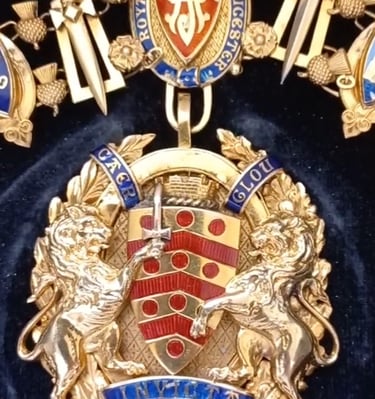
The badge consists of the City arms in repousse work, comprising a wreath of oak and laurel surrounding a garter and two rampant lions, with the Royal arms in red enamel at the top, and a ribbon bearing in purple enamel “Caer Glou”, the earliest known name of the City, and on another ribbon the City motto “Fides invicta triumphat”, also in purple enamel.
The sword and axes are in platinum and the whole of the other portions of the chain are made of 18-carat gold.
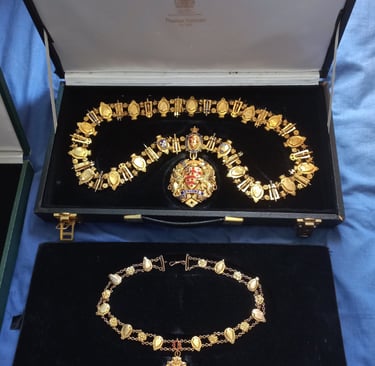
Sheriff's Chains of Office together with that of the Sheriff's Consort
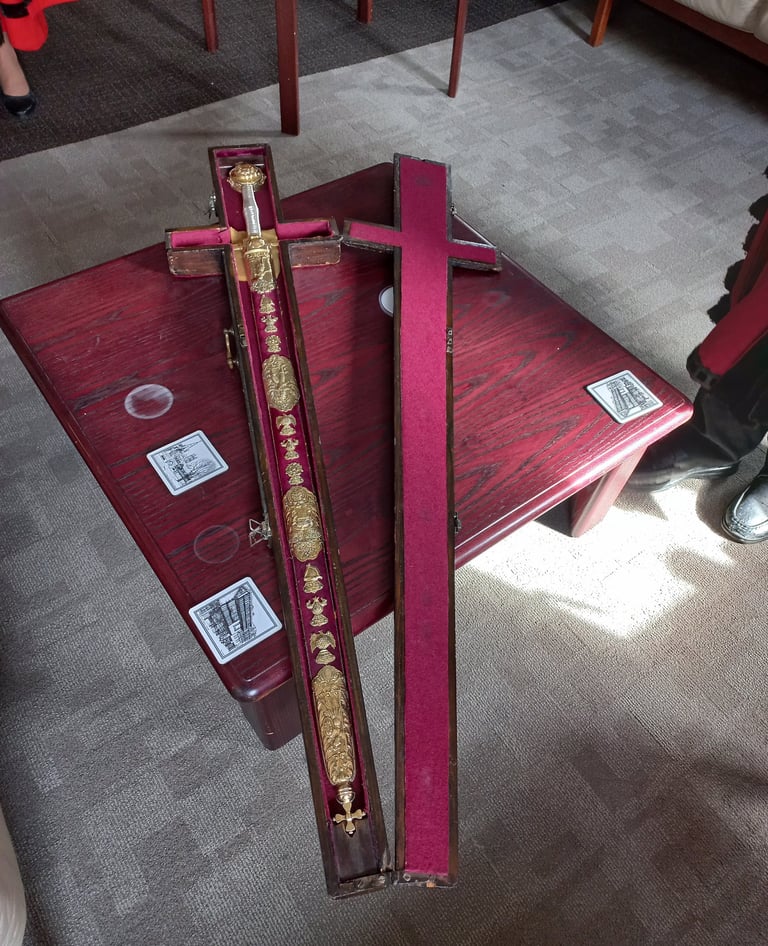
The present sword of State was probably obtained in 1627 when an important Charter was granted to the city by King Charles I. The Corporation records show that it was stripped of all emblems of royalty in 1652 and again altered at the Restoration in 1660. Of the original sword there still remains the blade - of Solingen make, with the wolf mark - and the hilt with its pommel and quillons. The sides of the pommel bear the royal arms of Charles II and the city arms of 1652. The grip is covered with silver wire and the cross guard is adorned on each side with one large and two small escallop shells. The sheath is covered with crimson velvet. The uppermost locket retains on one side the figure of Justice; the other side originally bore and inscription, but this has been erased and a later one engraved in its stead: “Gloucester, Toby Jordan, Esq., Maior Anno Regni Regis Car. 2nd XII Annoq Domi 1660”
The second locket has on one side the King, standing erect in armour and brandishing a sword; the other side shows the King riding over his fallen foes. The third locket has on one side the royal arms and supporters crowned in a circle between an oak tree above and the city arms below, wrought with a figure of Fame blowing a trumpet on one side and a fully-armed female figure on the other. The whole ends in a cruciform ornament instead of a crown. The interspaces are filled with the rose, thistle, harp and fleur-de-lis, each one crowned. The sword is 51 inches in length.